
Top 10 Mistakes New Stock Traders Make and How to Avoid Them
Why Most New Traders Fail in the Share Market

Most beginners don’t lose because of the market. They lose because of avoidable mistakes.
- Introduction:
When someone opens a trading account for the first time, there is energy. Charts look exciting. Nifty moves 80–100 points in a day. Bank Nifty gives sharp spikes. Options show 20–30% movement in minutes.
It feels like opportunity is everywhere.
But after training traders for years and trading myself through different market phases — bull runs, crashes, sideways markets — I can tell you something honestly: most beginners don’t lose because the market is difficult. They lose because they approach it incorrectly.
Let’s talk about the mistakes I see again and again. Not theory. Real behaviour from Indian retail traders.
1. Trading Without Learning First
Many beginners start with F&O. Not because they understand it — but because it looks fast.
They learn how to buy a call option. They don’t understand why its price falls even when Nifty hasn’t moved much. They see premium dropping and assume “operator game.”
It’s not operator game. It’s time decay.
I remember one student who bought weekly Bank Nifty calls in the morning expecting expiry profit. By 2 PM, the premium had reduced sharply. The index moved barely 30 points. He was shocked.
He had entered without understanding option Greeks, volatility, or expiry behaviour.(Learn Basics)
That first shock could have been avoided.
What to do instead:
Spend time understanding market structure first — cash market, futures, options basics. Learn how price behaves during trending vs sideways sessions. Start small. Your first goal is not profit. It is clarity.
2. Following Random Tips
Telegram tips are attractive because they remove responsibility. If it works, you feel smart. If it fails, you blame the tip provider.
But here’s the problem — when you don’t know why you entered a trade, you also don’t know when to exit.
I have seen traders buy a stock because someone said, “Upper circuit pakka.” The stock falls 8%. They don’t know whether to hold, average, or exit. Stress begins.
Conviction borrowed from someone else is weak.
Better approach:
Before entering any trade, ask yourself:
Can I explain in one clear sentence why I am taking this trade?
If the answer is no, step back.
Build a simple strategy. Even a basic support-resistance method is better than blind following.
3. Putting Too Much Money in One Trade
This usually happens after initial success.
A trader makes ₹7,000 profit in two option trades. Confidence rises. Next trade — double lot size. “Momentum strong hai.”
Suddenly, a sharp reversal. Loss wipes out previous gains plus more.
In Bank Nifty, 150–200 point moves can happen quickly. Option premiums react violently. If your position size is large, small market movement becomes big financial damage.
What I tell beginners clearly:
Your capital is oxygen.
Without it, you cannot survive in the market.
Risk a small fixed percentage per trade. Even if you lose five trades in a row, your account should still be healthy.
4. Expecting Trading to Replace Salary Immediately
This expectation creates pressure. Pressure leads to mistakes.
I often hear:
“Sir, I need at least ₹2,000 daily from market.”
Market does not know your financial needs.
Some days Nifty trends beautifully. Some days it stays inside 40-point range. If you force trades to meet daily income targets, you will overtrade.
Professional traders focus on process. Income becomes a byproduct over time.
Shift your mindset:
In the first year, focus on skill development and consistency.
If you treat trading as shortcut income, frustration will build quickly.
5. Refusing to Accept Small Loss, If Stop Loss Hits
This one hurts the most.
A beginner buys Nifty futures. Keeps mental stop-loss. Market starts falling. Instead of exiting, he waits. “Support ke paas hai.” Then “Thoda aur rukte hain.” By afternoon, loss becomes emotionally heavy.
The refusal to accept small loss converts manageable damage into serious drawdown.
A stop-loss is not admission of failure. It is professional discipline.
Plan your exit before entry. Not during panic.(Downlod our free trade plan sheet)
6. Trading Every Small Move
Not every candle is an opportunity.
New traders sit in front of screen for hours. Every breakout looks tradable. Every small pullback looks like entry.
By end of day:
10 trades taken
Brokerage high
Mind exhausted
Net result negative
Sometimes the best trade is patience.
Sideways markets are designed to test discipline. If your setup is not present, stay out. You don’t get extra marks for activity.
7. Investing in Stocks Without Understanding the Business
During bull markets, many stocks run fast. Social media fills with “multibagger” discussions.
Retail investors buy small-cap stocks at high valuations without checking fundamentals. When correction comes, fear dominates. They exit near bottom.
I have seen people buy companies without knowing what product they sell.
When price falls, there is no confidence to hold.
Basic understanding of revenue growth, debt level, and industry position gives psychological strength during volatility.
You don’t need to become CA. But you must know what you own.
8. Emotional Decisions: Fear, Greed, FOMO
Let’s be honest. Emotions drive most beginner trades.
Nifty breaks previous high. You hesitate. Then it moves further. Suddenly FOMO hits. You enter late. Market pulls back.
Or your trade is in profit. Instead of booking at planned target, greed whispers — “Hold more.” Market reverses.
I once asked a trader to maintain journal including emotional state. After 30 trades, pattern was clear — most losses came from impulse entries.
Market rewards rule-following behaviour, not excitement.
Train yourself to act on structure, not emotion.
9.Ignoring Risk-Reward Logic
Many beginners focus only on “kitna profit hoga.”
They rarely calculate:
How much am I risking?
Is the potential reward worth that risk?
If you risk 60 points to make 20, even good accuracy won’t save you long term.
Trading is mathematics combined with psychology.
Even with 40–50% accuracy, you can grow — if reward is consistently larger than risk.
Before entering, calculate both sides. This habit alone filters many poor trades.(For More dowload free Position Sizing Calculator)
10.Not Reviewing Their Own Performance
This is subtle but powerful.
Ask a beginner:
What is your win rate?
What setup works best for you?
What is your average loss?
Most don’t know.
Without review, improvement is random.
Maintain a simple trading journal. Write entry reason, exit reason, emotion, result. Review weekly.
You will discover patterns:
Certain time of day suits you.
Certain setups fail repeatedly.
Certain emotional states lead to poor decisions.
Self-awareness improves performance more than adding new indicators.
A Realistic View About Trading
Let me share one observation from experience.
The market does not reward intelligence alone. It rewards emotional control and risk management.
I have seen highly educated professionals lose heavily because they refused to cut losses. I have seen average students become consistent traders because they respected risk.
If you remove these 10 mistakes from your behaviour:
Your losses reduce automatically.
Your confidence becomes stable.
Your decisions become calmer.
Will you win every trade? No.
Will drawdowns come? Yes.
But you will survive. And survival gives you time to improve.
In Indian markets — whether trading Nifty, Bank Nifty, or investing in quality stocks — long-term growth belongs to disciplined participants.
Start small.
Protect capital.
Focus on process.
Profits come slowly. But when they come through discipline, they stay.
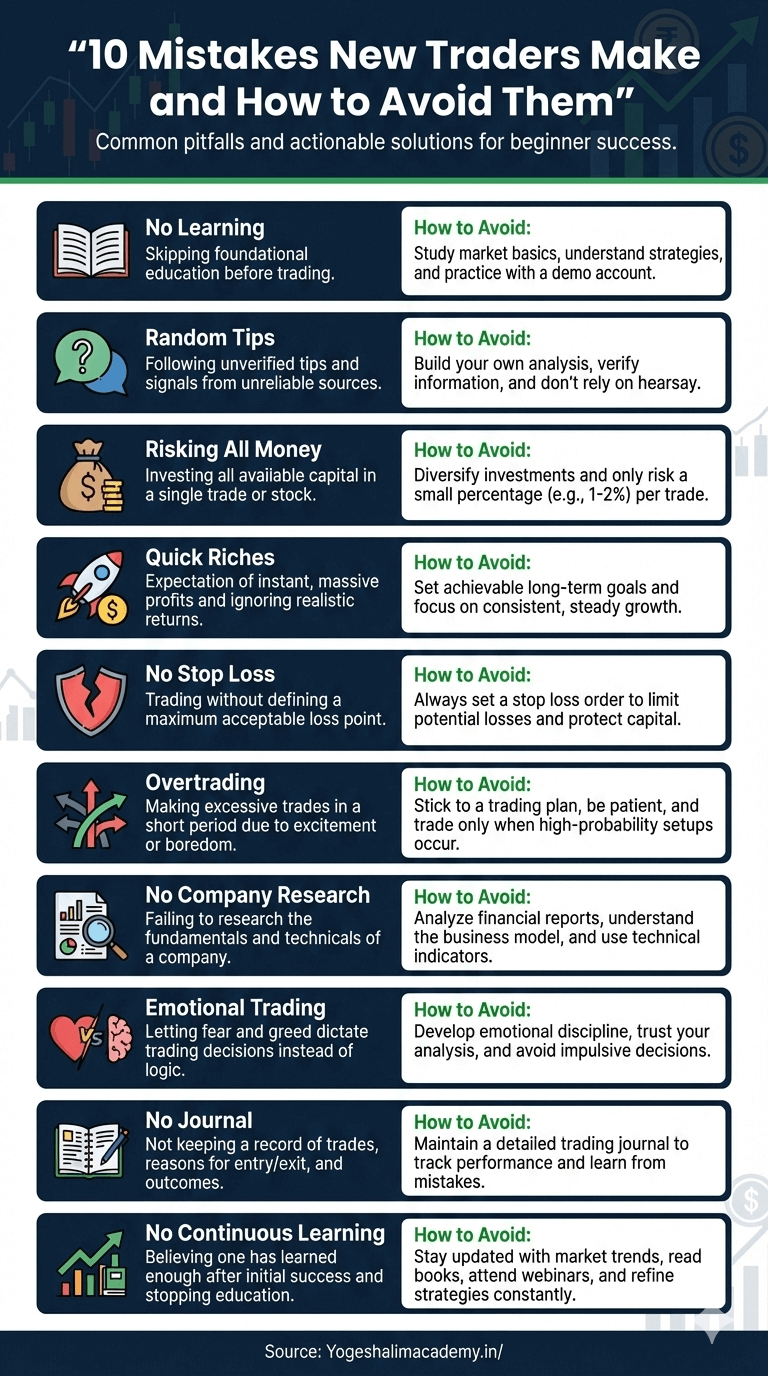
That is the difference between excitement-based trading and professional trading. In image below you can see all these point in picture form.
Conclusion
Success in the stock market is not about luck.
It is about education, discipline, and patience.
Avoid these 10 mistakes — and you will already be ahead of 80% of beginners.
How Yogeshalimacademy Helps You Avoid These Mistakes
Our trainer Yogesh Alim has over 10 years of share market experience, and guest trainer Prof. Rajendra Mirgal brings 25+ years of expertise in advanced strategies like Delta Trading.
We offer practical, step-by-step courses that help you trade confidently:
- Basics of Share Market – Learn the foundation
- Technical Analysis – Master chart reading
- Intraday & Swing Trading – Short-term profit strategies
- Futures, Options & Delta Trading – Safe, advanced trading methods
Final Words:
Trading can be profitable if you start with knowledge, discipline, and the right mindset. Avoiding these 10 mistakes will save you time, money, and stress.
📞 Want to start your trading journey the right way?
Check out our Stock Market Courses »
Read Our Popular articlas: